What We Believe
What We Believe
As an Anglo-Catholic church, which from our founding has been committed to the principles of the Catholic Revival in the Church of England from the 19th Century, St. Michael and All Angels’ Church adheres to the Faith and tradition of the Universal Church. The marks of the Church are that she is One, Holy, Catholic, and Apostolic. This is summarized in the three historic Creeds or profession of faith: The Apostles’ Creed, The Nicene Creed, and the Athanasian Creed.
The Church is one, because she is the living Body of Christ in the world. Through Holy Baptism, the individual members who have diverse talents in the Body, represent Christ and are to share the Gospel to the world. While we lament the sad divisions which have rent the fabric of the Church, especially in the schism between the Eastern and Western Church (in the 11th Century), and the Protestant Reformation (16th Century), nevertheless, we pray for the healing of those divisions, echoing Our Lord’s prayer “that they all may be one.” The Body of Christ, whose members we are, pray for a return to Catholic and Apostolic unity in both corporate and private prayer.
The Church is Holy because she has the life of Christ coursing through her. This is primarily found in the Sacraments, which are the outward and visible sign of an inward and spiritual grace given by Christ. The Sacraments are the sure and certain sign of Our Lord’s power working through his living Body, the Church. There are seven Sacraments: Holy Baptism, Holy Confirmation, Holy Eucharist, Holy Penance, Holy Matrimony, Holy Orders, and Holy (or Extreme) Unction. These means of grace are freely offered to all who have been incorporated into the Body of Christ through Holy Baptism.
The Church is Catholic because she professes that which has been taught in all times and in all places, to paraphrase the 5th Century theologian St. Vincent of Lerins. The Catholic Church is found in all ages throughout the world, teaching only what the Universal (another translation of katholicos) Church has taught from the Apostles, through the lens of Holy Scripture, and the Tradition of the Holy Fathers of the Ecumenical Councils of the Church.
The Church is Apostolic because her bishops are traced back in an unbroken line to the Apostles. The Apostles chose their successors who in turn chose their successors, down to the present. When the Church of England went into schism from Rome in the 16th Century, adopting some of the principles of the Continental Reformation, the desire to preserve the orders of Bishop, Priest, and Deacon as it had been since the Apostles’ time, was stated in the Book of Common Prayer. This guarantee of unbroken descendants in Holy Orders, specifically the order of Bishops, is known as the Apostolic Succession.
The Creeds
Unlike the 1662 Book of Common Prayer of the Church of England, the first American Book of Common Prayer of 1789 did not include the Athanasian Creed as part of its services. However, in the 1979 edition of the Prayer Book the Athanasian Creed was made part of the Historic documents, which are important to the maintenance of the faith and practice of the Episcopal Church. .
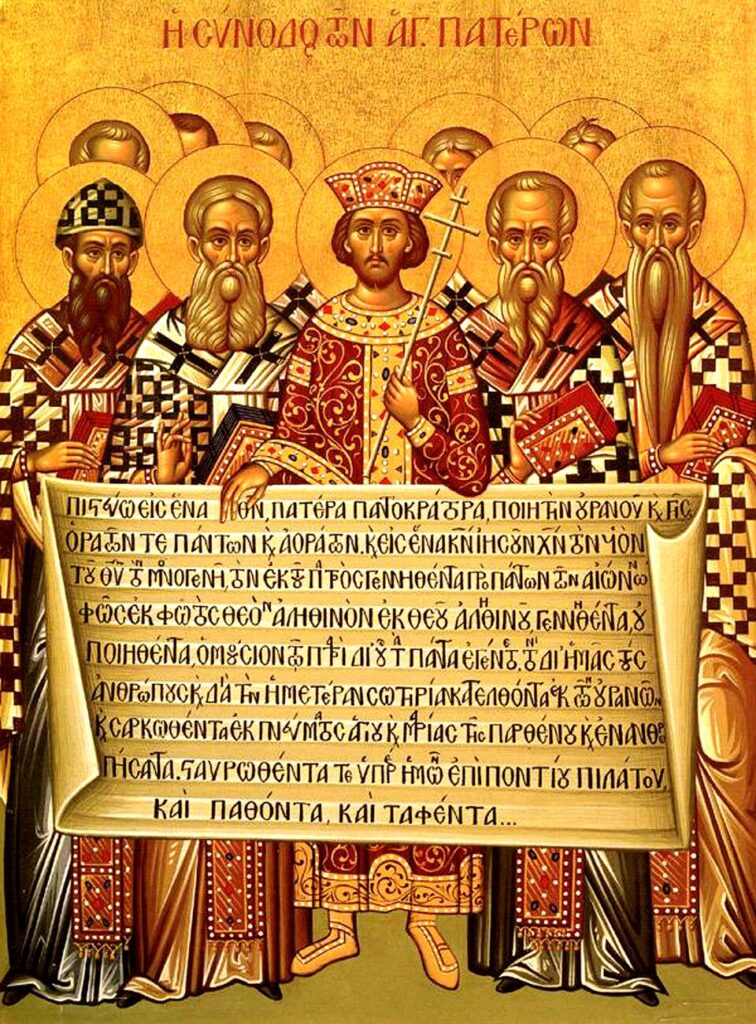
The Nicene Creed
I believe in one God,
the Father Almighty,
maker of heaven and earth,
and of all things visible and invisible;
And in one Lord Jesus Christ,
the only-begotten Son of God,
begotten of his Father before all worlds,
God of God, Light of Light,
very God of very God,
begotten, not made,
being of one substance with the Father;
by whom all things were made;
who for us men and for our salvation
came down from heaven,
and was incarnate by the Holy Ghost of the Virgin Mary,
and was made man;
and was crucified also for us under Pontius Pilate;
he suffered and was buried;
and the third day he rose again according to the Scriptures,
and ascended into heaven,
and sitteth on the right hand of the Father;
and he shall come again, with glory,
to judge both the quick and the dead;
whose kingdom shall have no end.
And I believe in the Holy Ghost the Lord, and Giver of Life,
who proceedeth from the Father and the Son;
who with the Father and the Son together is worshiped
and glorified;
who spake by the Prophets.
And I believe one holy Catholic and Apostolic Church;
I acknowledge one Baptism for the remission of sins;
and I look for the resurrection of the dead,
and the life of the world to come. Amen.
The Apostles’ Creed
The Apostles’ Creed is an ancient profession of faith, which was first used at Holy Baptism in the Roman Church. It is primarily used at the Daily Offices of Matins (Morning Prayer), [Book of Common Prayer pages 53 or 96] and Evensong (Evening Prayer) [BCP pages 66 or 120].
It is the introduction to the Baptismal Covenant in Holy Baptism [BCP p. 304].
I believe in God, the Father almighty,
maker of heaven and earth;
And in Jesus Christ his only Son our Lord;
who was conceived by the Holy Ghost,
born of the Virgin Mary,
suffered under Pontius Pilate,
was crucified, dead, and buried.
He descended into hell.
The third day he rose again from the dead.
He ascended into heaven,
and sitteth on the right hand of God the Father almighty.
From thence he shall come to judge the quick and the dead.
I believe in the Holy Ghost,
the holy catholic Church,
the communion of saints,
the forgiveness of sins,
the resurrection of the body,
and the life everlasting. Amen.
The Creed of Saint Athanasius
As found on page 864 of the 1979 Book of Common Prayer:
This text is not like the Apostles’ or Nicene Creeds. This profession of faith has its origin in Spain during the 5th and 6th Centuries. Arianism, a heresy teaching that the Son of God was not “of one substance” or equal Being with God the Father. Neither was he eternally begotten of the Father, as the orthodox proclaimed. This heresy, stamped out in the Eastern Church in the 4th Century, stubbornly persisted in the West. The creed, named after the greatest defender of orthodox Christianity, St. Athanasius of Alexandria (d. 373), sought to combat Arianism while also promoting the doctrine of the two Natures of Christ (perfect God and perfect Man, one Person in two Natures) which had been decided at the third and fourth Ecumenical Councils (Ephesus in 431 and Chalcedon in 451). According to the English Book of Common Prayer (1662), the Athanasian Creed is said or sung at Matins in place of the Apostles’ Creed on Christmas Day, the Epiphany (January 6), St. Matthias (February 24, 25 in leap years), Easter Day, Ascension Day, Whitsunday (Pentecost), Trinity Sunday, Nativity of St. John Baptist (June 24), St. James (July 25), St. Bartholomew (August 24), St. Matthew (September 21), SS. Simon and Jude (October 28), and St. Andrew (November 30). In the Episcopal Church, this creed is used as a supportive document of the Prayer Book catechism.
Whosoever will be saved, before all things it is necessary that he hold the Catholic Faith. Which Faith except everyone do keep whole and undefiled, without doubt he shall perish everlastingly.
And the Catholic Faith is this: That we worship one God in Trinity, and Trinity in Unity, neither confounding the Persons, nor dividing the Substance. For there is one Person of the Father, another of the Son, and another of the Holy Ghost. But the Godhead of the Father, of the Son, and of the Holy Ghost, is all one, the Glory equal, the Majesty co-eternal. Such as the Father is, such is the Son, and such is the Holy Ghost. The Father uncreate, the Son uncreate, and the Holy Ghost uncreate. The Father incomprehensible, the Son incomprehensible, and the Holy Ghost incomprehensible.
The Father eternal, the Son eternal, and the Holy Ghost eternal. And yet they are not three eternals, but one eternal. As also there are not three incomprehensibles, nor three uncreated, but one uncreated, and one incomprehensible.
So likewise the Father is Almighty, the Son Almighty, and the Holy Ghost Almighty. And yet they are not three Almighties, but one Almighty. So the Father is God, the Son is God, and the Holy Ghost is God. And yet they are not three Gods, but one God. So likewise the Father is Lord, the Son Lord, and the Holy Ghost Lord. And yet not three Lords, but one Lord. For like as we are compelled by the Christian verity to acknowledge every Person by himself to be both God and Lord, So are we forbidden by the Catholic Religion, to say, There be three Gods, or three Lords. The Father is made of none, neither created, nor begotten. The Son is of the Father alone, not made, nor created, but begotten. The Holy Ghost is of the Father and of the Son, neither made, nor created, nor begotten, but proceeding. So there is one Father, not three Fathers; one Son, not three Sons; one Holy Ghost, not three Holy Ghosts. And in this Trinity none is afore, or after other; none is greater, or less than another; But the whole three Persons are co-eternal together and co-equal. So that in all things, as is aforesaid, the Unity in Trinity and the Trinity in Unity is to be worshipped. He therefore that will be saved is must think thus of the Trinity.
Furthermore, it is necessary to everlasting salvation that he also believe rightly the Incarnation of our Lord Jesus Christ. For the right Faith is, that we believe and confess, that our Lord Jesus Christ, the Son of God, is God and Man; God, of the substance of the Father, begotten before the worlds; and Man of the substance of his Mother, born in the world; Perfect God and perfect Man, of a reasonable soul and human flesh subsisting. Equal to the Father, as touching his Godhead; and inferior to the Father, as touching his manhood; Who, although he be God and Man, yet he is not two, but one Christ; One, not by conversion of the Godhead into flesh but by taking of the Manhood into God; One altogether; not by confusion of Substance, but by unity of Person. For as the reasonable soul and flesh is one man, so God and Man is one Christ; Who suffered for our salvation, descended into hell, rose again the third day from the dead. He ascended into heaven, he sitteth at the right hand of the Father, God Almighty, from whence he will come to judge the quick and the dead. At whose coming all men will rise again with their bodies and shall give account for their own works. And they that have done good shall go into life everlasting; and they that have done evil into everlasting fire.
This is the Catholic Faith, which except a man believe faithfully, he cannot be saved.